Destinations
Sail down the Danube in 2027 to explore Europe in style
From baroque cities to dramatic landscapes, some of Europe’s most beautiful sights are revealed on a cruise down the majestic Danube.
By Sue Bryant
Rising in Germany’s Black Forest and flowing across Europe to the Black Sea, the Danube carves its way through woodland, mountain ranges, vineyard-covered hills, plains and steppes. Ten countries and four capitals, Vienna, Bratislava, Budapest and Belgrade, lie along its course.
Little wonder, then, that Danube cruises are so popular. The river offers endless cultural variety; over the centuries, it’s formed the northern boundary of the Roman Empire, eased the path of the Crusades and served as a transport artery for the Turks as they pushed into Europe. You can visit monasteries and castles, cycle, hike, taste wine and discover dynamic cities and medieval towns.
Explore this fascinating river on Saga’s Spirit of the Danube and the new Spirit of the Lorelei, launching in July 2027. Extend your holiday, too, with Saga’s exciting city stays in Vienna, Budapest and Prague.
Here are 10 Danube ports to see on your next cruise.
Regensburg: a medieval jewel with Roman roots
Founded by Marcus Aurelius more than 2,000 years ago at the confluence of three rivers, the Regen, the Danube and the Naab, Regensburg is the oldest city on the Danube.
Things to see in this UNESCO World Heritage Site include the grand, patrician houses dating back to the 12th century and the magnificent Gothic cathedral, which contains exquisite stained-glass windows. Check out the impressive Stone Bridge, too, built in 1146 and with its 16 arches, a fine example of medieval engineering.
Visit Regensburg on Saga’s Rhine, Main and Danube Explorer cruise on the new Spirit of the Lorelei.
Passau: City of Three Rivers
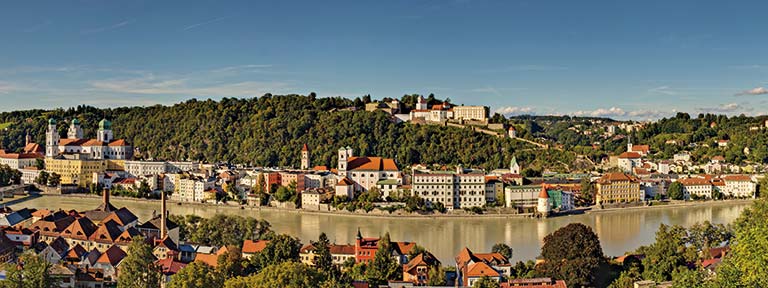
Passau sits on a peninsula at the confluence of the Danube, the Ilz and the Inn rivers against a backdrop of wooded hills. The city was rebuilt in the 17th century after a devastating fire and is famed for its Italianate baroque architecture, which gives it an entirely different feel from the half-timbered medieval towns you’ll find elsewhere along the Danube. Some describe it as ‘the Venice of Bavaria.’
Passau’s skyline is dominated by the green, onion-domed towers of St. Stephen’s Cathedral, which contains Europe’s largest pipe organ. Arrive in summer and you could catch one of the daily recitals here. Then stroll along the riverfront to see the grand former homes of wealthy merchants and stop in a leafy beer garden to sample the local brews.
Visit Passau on Saga’s Cultural Cities of the Danube with Budapest City Stay itinerary, sailing on the new Spirit of the Lorelei.
Linz: Baroque beauty with a buzzing atmosphere
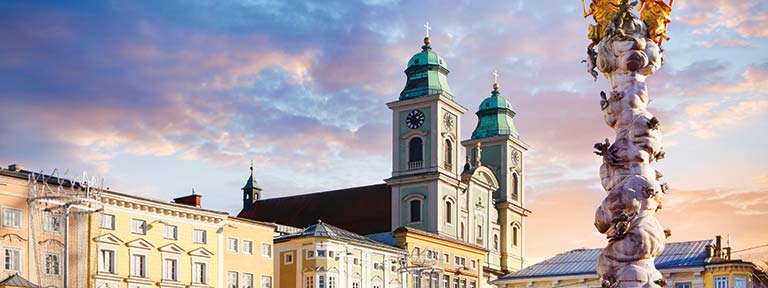
Linz combines a baroque heart with futuristic architecture and a buzzing creative scene. Stroll through the cobbled streets of the centre and then, for contrast, visit the Ars Electronica Center for a glimpse into a futuristic, or perhaps not so futuristic world in which robots, AI and electronic art come together.
Ride the Pöstlingbergbahn, one of Europe’s steepest adhesion railways, up to Pöstlingberg to the 18th century Basilica of the Seven Sorrows of the Virgin Mary, an atmospheric pilgrimage site. Back in town, sample the city’s signature Linzertorte, a pastry base with a jam filling and a criss-cross, almond-encrusted pattern on top.
You can visit Linz on Saga’s Wachau Valley to Vienna cruise with Prague City Stay on Spirit of the Danube.
Melk: Fairy-tale medieval town with a magnificent abbey
Melk is defined by its elegant, baroque Benedictine abbey, an important spiritual centre for almost a millennium, standing tall above the Danube on a rocky bluff.
The abbey was founded in 1089 and rebuilt in the early 18th century. Inside, you’ll find gleaming marble and elaborate frescoes, not to mention the exquisite library, where priceless books are displayed on bookshelves of dark wood and gold. The gardens are beautiful, too; make a detour to the café here for a slice of apricot cake, made from fruit grown in the orchards that line the verdant Wachau Valley. Melk’s historic centre looks like a fairy-tale illustration with cobbled streets and pastel-hued houses.
You can visit Melk on a Scenic Gems of the Danube cruise between Vienna and Budapest cruise between Vienna and Budapest on Spirit of the Danube.
Dürnstein: one of the Danube’s finest gems
The enchanting village of Dürnstein lies deep in the Wachau Valley, one of the most beautiful stretches of the Danube, its hills green with braided vineyards in summer and the forests turning fiery shades of ochre and scarlet in autumn. It is a photographer’s dream with the blue-and-white pepperpot tower of the baroque monastery on the riverbank and, high on the hill beyond, the jagged outline of Kuenringer Castle, where Richard the Lionheart was imprisoned in the 12th century. The ruined castle is accessed via a steep, sometimes rocky path, with the reward from the top of magnificent views over the river, hills and vineyards.
Get to know this pretty riverside town on Spirit of the Lorelei’s Vienna, Budapest and the Scenic Danube itinerary and Vienna, Budapest and the Scenic Danube on Spirit of the Danube.
Vienna: Habsburg opulence and cafe culture
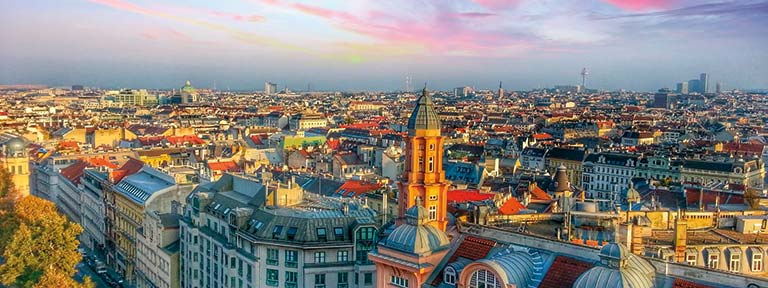
Austria’s glorious capital contains opulent Habsburg palaces, world-class art museums, dancing white stallions and opera to fill your time, and there’s much more to see. Visit pretty Grinzing, on the edge of the vineyards that lie inside the city limits, for wine tasting. Graze on mouth-watering street food in the aromatic Naschmarkt or while away a morning in one of the famous coffee houses. Fans of the 1949 film noir The Third Man could even take a sewer tour, visiting the spot where the iconic chase scene was shot.
Saga’s Vienna, Bratislava and Budapest Explorer with Vienna City Stay itinerary starts with three nights in Vienna, giving you time to explore the city.
Esztergom: Hungary’s former royal residence
Esztergom packs a big punch for a small town; its vast, neoclassical basilica, Hungary’s largest, can be seen from miles around over the river’s lush plains. The cathedral is flanked by a red-brick castle, which was home to Hungary’s royals for more than 300 years from the tenth until the mid-13th century, when King Béla IV of Hungary moved the Royal seat to Buda. A tour of the castle includes the Treasury, home to breathtaking riches including jewelled chalices, gleaming gold artefacts and ornate ceremonial robes.
As you leave Esztergom, the river curves round the Danube Bend, one of the most scenic stretches of the river, a region of farmland, river beaches and wooded hills that once served as royal hunting grounds. Take it all in, plus a stay in Vienna, on Saga’s Vienna, Bratislava and Budapest Explorer on Spirit of the Lorelei itinerary or Vienna. Bratislava and Budapest on Spirit of the Danube.
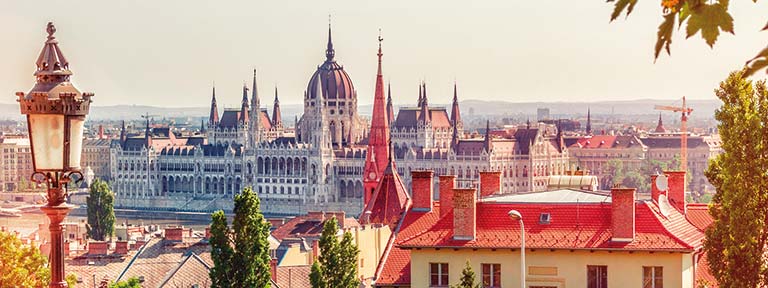
Budapest: baths, boulervards and a spectacular castle
The Danube flows through the heart of the Hungarian capital, with jaw-dropping views at every turn. Budapest is two cities in one. Buda clings to a steep hill, dominated by Buda Castle, the Fisherman’s Bastion and Matthias Church. In contrast, the Pest side of the river is all grand boulevards, tree-lined squares and cosy cafés, not forgetting the magnificent neo-Gothic Parliament Building that dominates the waterfront.
Once you’ve seen the big sights, check out one of the many thermal baths that are scattered across the city, many of them in elaborate art nouveau buildings.
Spirit of the Danube’s From Budapest to Vienna cruise is the perfect introduction to Budapest, with two nights to explore the city.
Novi Sad – Serbia’s intriguing second city
Novi Sad, Serbia’s second city, is dominated by the vast Petrovaradin Fortress. Military history enthusiasts will love visiting the eerie warren of defensive tunnels that criss-cross the rock under the citadel.
Novi Sad is also the gateway to Fruška Gora National Park, where dense forests of linden, oak and beech cling to steep hills and birdsong fills the air. Some 17 Serbian Orthodox monasteries are hidden amid this lush splendour, the monks and nuns producing rajika fruit brandy, wine and honey. You can spend a day here as part of Saga’s Budapest to the Black Sea cruise.
Golubac: atmospheric town with a spectacular fortress

Golubac lies at the western entrance to the spectacular Iron Gates Gorge, some 83 miles of sheer-sided canyons and forested hills, with Romania on the north bank and Serbia on the south. The 14th-century fortress here is truly magnificent, its crenellated walls and nine towers clinging to a steep rocky outcrop.
The stronghold served as a base for the Turks for more than two centuries as they made forays to the north and west. It’s in ruins now but you can explore with a guide and learn about the complex construction – and some of the myths and legends that surround this atmospheric place.
Explore the fortress as an excursion on Saga’s Historic Highlights from Budapest to Belgrade cruise, sailing on the new Spirit of the Lorelei.
The opinions expressed are those of the author and are not held by Saga unless specifically stated.
The material is for general information only and does not constitute investment, tax, legal, medical or other form of advice. You should not rely on this information to make (or refrain from making) any decisions. Always obtain independent, professional advice for your own particular situation.