Experiences
12 incredible historical sights you can see from a river cruise
From medieval fortresses and palaces to castles, cathedrals and windmills, here are 12 of the best sights to see on your next river cruise adventure...
by Sue Bryant
1. The Rhine Gorge
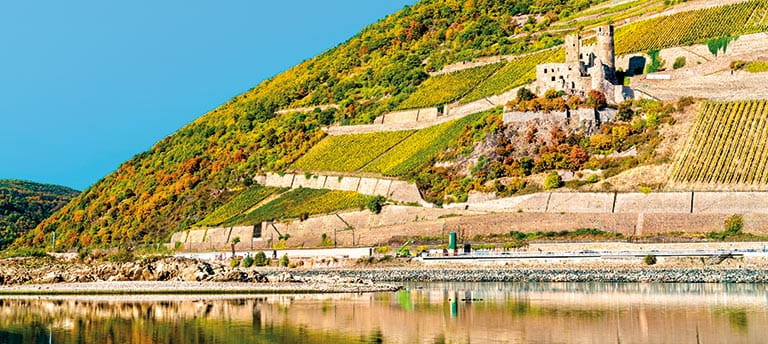
Port: Koblenz
Between Bingen and Koblenz, the Rhine carves its way for 40 miles between sheer-sided hills draped with vineyards and forests. More than 40 castles and fortresses, many dating back to the Middle Ages, guard the hilltops and river bends. Colourful little wine-growing towns cling to the banks and invite exploration – Boppard, all half-timbered medieval houses and vine-shaded pub gardens, is one of the loveliest.
Fun fact: The owners of the 14th-century Pfalzgrafenstein, perched on an island, would use a chain across the river to capture passing boats. The captain had the choice of paying a toll – or languishing in the castle's dank floating dungeon.
How can I experience this?
2. Wachau Valley
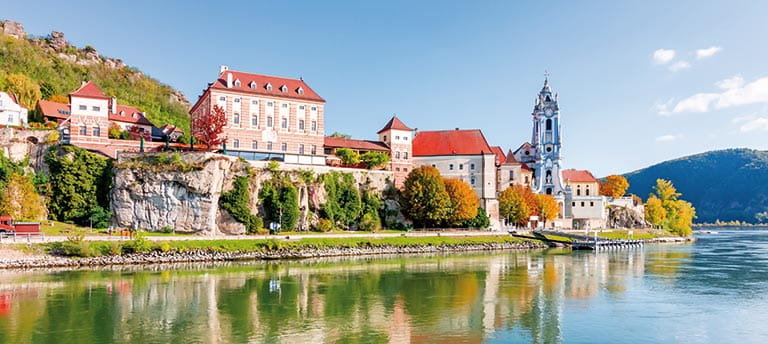
Port: Krems
The 25-mile Wachau Valley is one of the most scenic stretches of the Danube. Steep hills rise up either side of the river, immaculate vineyards clinging to their slopes, and apricot orchards line the banks. Sights you won't want to miss include the majestic Melk Abbey, a riot of Baroque splendour perched on a rocky outcrop overlooking the river, and the ruin of 12th-century Dürnstein Castle. This is where Richard the Lionheart was imprisoned in 1192 and it's worth the trek up the hill for the far-reaching views across the bucolic countryside.
Fun fact: The local apricot, Wachauer Marille, is protected by the EU. Try these little flavour bombs in pastries, schnapps and Marrillenknödel, the Wachau's famous apricot dumpling.
How can I experience this?
Vienna and the Cities of the Danube
3. Regensburg Old Town
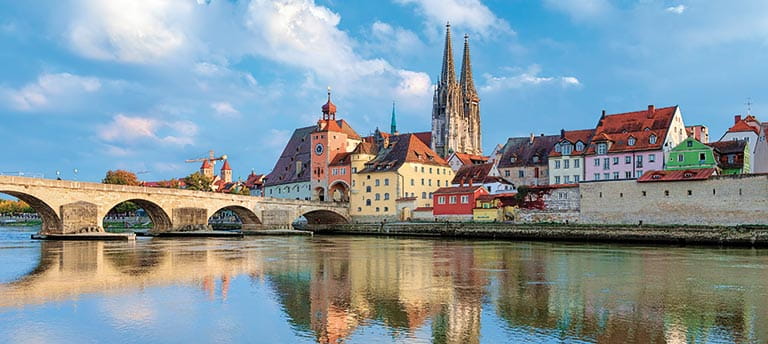
Port: Regensburg
Largely spared by bombing during WWII, Regensburg's Old Town (or Altstadt) is one of Europe's best preserved medieval cities, a jumble of cobbled lanes, crooked houses and enchanting squares, its skyline defined by the twin spires of the gothic St Peter's Cathedral. Cross the Danube via the Stone Bridge, dating from 1146, and step back in time. Explore the cathedral, with its jewel-like stained glass windows, admire the Golden Tower and the Town Hall, and check out the Porta Praetoria, one of only two surviving Roman gates in Germany.
Fun fact: Don't leave Regensburg without sampling a bratwurst from Würstkuchl, which claims to be the world's oldest sausage kitchen.
How can I experience this?
Vienna, Budapest and the Scenic Danube
4. The Residence Palace, Würzburg
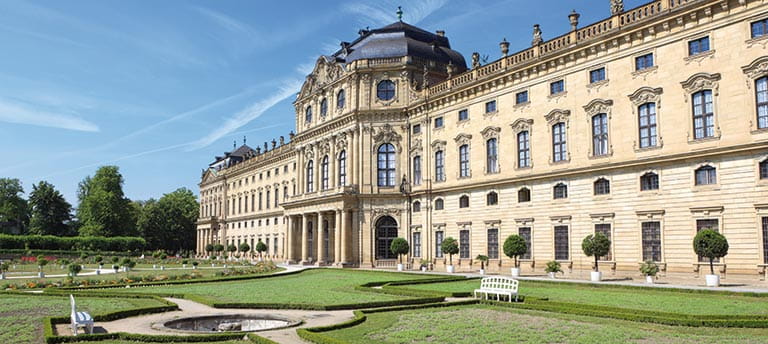
Port: Würzburg
One of Germany's most important Baroque palaces, the Residenz at Würzburg was built in the mid-18th century for prince-bishop Johann Philipp Franz von Schönborn. Its gilded opulence defies the imagination – don't miss the magnificent Treppenhaus staircase, the ceiling here adorned with the world's largest fresco, by Giovanni Battista Tiepolo. Many of the rooms are used by the city's government and university but you can tour the 40 most lavish salons, including the stuccoed White Hall and the dazzling Spiegelkabinett, or Hall of Mirrors.
Fun fact: The interior decoration of the original Würzburg Residence was so spectacular that it prompted a new school of design, Würzburg Rococo.
How can I experience this?
Contrasts of the Rhine and Main
5. Kinderdijk
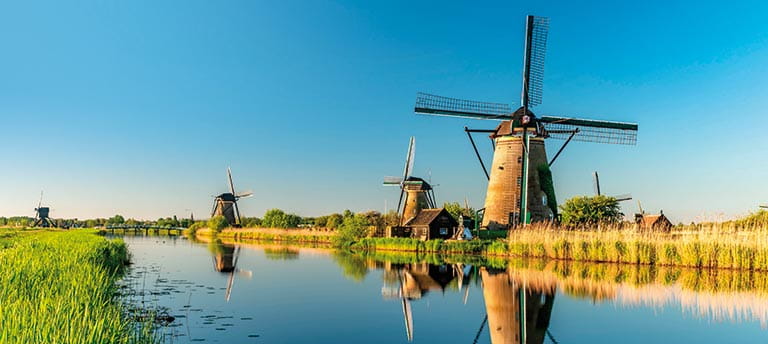
Port: Rotterdam
Pretty Kinderdijk is a dream photo opportunity. Just 30 minutes from Rotterdam, and usually offered as an optional excursion, this beautiful, canal-laced village is famed for its 19 perfectly preserved windmills, built in the 18th century to pump water from the lowlands between the Lek and Noord rivers. Two are open as museums, giving a fascinating glimpse into life as a miller as recently as the 1950s. The best way to explore is to rent a bike and pedal around the flat, circular 5-mile trail.
Fun fact: Although the mills have been replaced by diesel and electric water pumps, they still work and can be employed in the event of a power failure.
How can I experience this?
Highlights of Holland and Belgium
André Rieu in Maastricht: Rotterdam to Maastricht
6. Porta Nigra, Trier
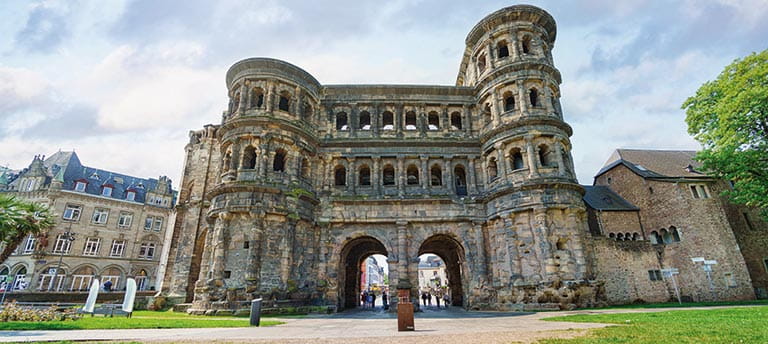
Port: Trier
Germany's oldest city, Trier was founded in 16 BC by the Emperor Caesar Augustus. Its sandstone city gate, Porta Nigra, built in 170 AD, is one of the most impressive relics of the era, not least because it was constructed without any use of mortar. The Latin name comes from the fact that the stone has blackened over the centuries. While you're on your quest to discover more Roman antiquities, visit the remnants of the 20,000-seat amphitheatre and the Barbara Baths, the largest bathing complex of the Roman Empire beyond Rome itself.
Fun fact: While Trier is most famous for its Roman antiquities, it was also the birthplace in 1818 of Karl Marx. A bronze statue of the philosopher stands on Simeonstiftplatz and you can visit his home on Brückenstrasse.
How can I experience this?
7. Le Grand-Place, Brussels
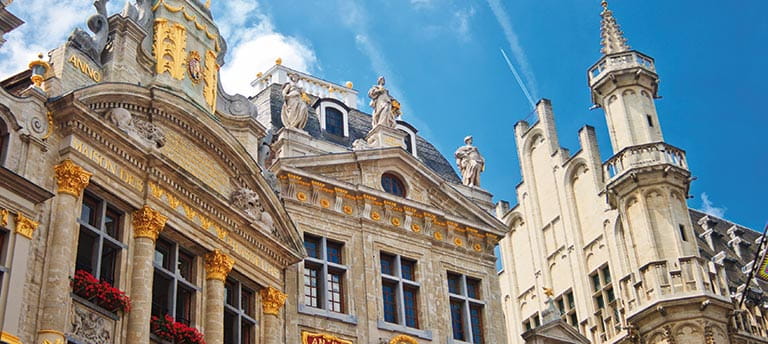
Port: Brussels
La Grand-Place, Brussels' cobbled market square, dates back to the 12th century, surrounded by magnificently eclectic architecture, with the 15th-century Hôtel de Ville, or City Hall, the star attraction. Much of what you see was rebuilt after bombardment by the French in 1695, although the spire of the Hôtel de Ville survived. Also overlooking the square is the Maison du Roi, housing the Brussels City Museum, and a collection of magnificent guild halls, mainly from the early 18th century, adorned with gables, elaborate symbols and statues that reflect the importance of the original occupants.
Fun fact: Every two years, in August, more than 500,000 begonias festoon the Grand-Place in a fragrant and colourful display. The next Flower Carpet will take place this year.
How can I experience this?
8. Buda Castle
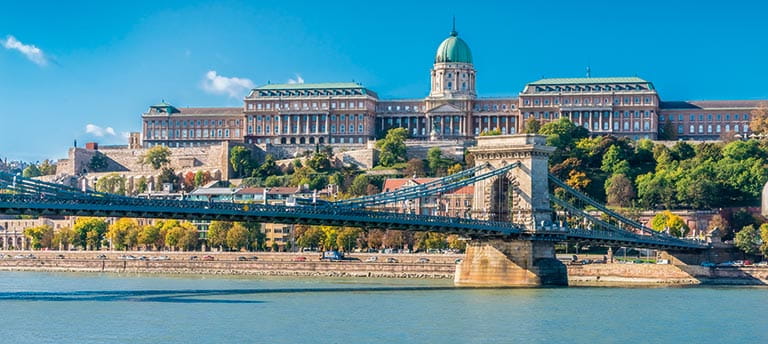
Port: Budapest
The whole complex of Buda Castle, spread across a plateau high above the Danube and dating back to 1265, became a UNESCO World Heritage Site in 1987. The castle complex has served as the seat of Hungarian royals and a fortress over the years, while today it's dedicated to culture. There's lots to see here, from Matthias Church, with its colourful tiled roof, to the Fisherman's Bastion, from where you'll enjoy the best views over the Pest side of the river. Visit the Royal Palace, which houses the Hungarian National Gallery, and the Castle Museum, which trace the history of the city over 2,000 years. Available as an optional excursion.
Fun fact: Check out the Raven Gate to the castle, installed in 1995. The black raven on the top is a symbol of the strength of King Matthias Corvinus, who in the 15th century was instrumental in transforming Hungary into a major European power.
How can I experience this?
Vienna, Budapest and the Scenic Danube
9. Cologne Cathedral
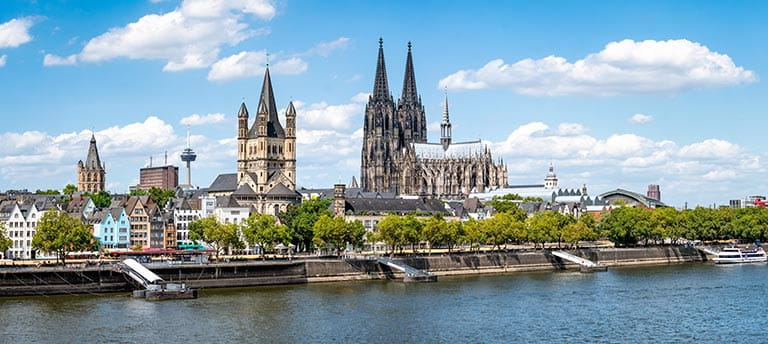
Port: Cologne
Cologne's magnificent cathedral, which took 600 years to build, dominates the landscape from miles around. Step inside and you'll be dazzled by the historical and artistic treasures here. The most important is the Shrine of the Magi, a gold, silver and enamel-encrusted sarcophagus that contains what's believed to be the remains of the Three Kings, donated in 1164 by the reigning Holy Roman Emperor to the Archbishop of Cologne.
Fun fact: Many of the medieval stained-glass windows were removed and stored in safety during WWII, although others had to be replaced. The rainbow-hued Cologne Cathedral Window, installed in 2007, was designed by local artist Gerhard Richter and comprises 11,500 pieces of glass.
How can I experience this?
Sights and Scenery of the Rhine
10. Schönbrunn Palace
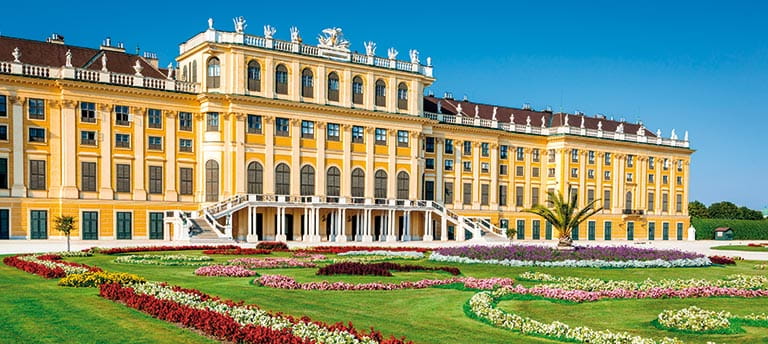
Port: Vienna
Vienna's answer to Versailles, Schönbrunn Palace, a Baroque confection of mirrored salons and gilded ceilings, was the lavish summer home of the Habsburg emperors. Artfully landscaped gardens include a maze, an orangery, elaborate fountains, a zoo and even some artificial Roman "ruins" for good measure.
You can tour 40 of the 1,400 rooms, including the dazzling Rococo-style Hall of Mirrors, the state apartments and Maria Theresa's Vieux-Laque room, a tribute to her late husband, done out in Chinese-style panels of gold and black lacquer.
Fun fact: In 1762, Mozart played in the Hall of Mirrors for the Empress Maria Theresa, adding another layer of history to this magnificent palace.
How can I experience this?
Vienna, Budapest and the Scenic Danube
11. Melk
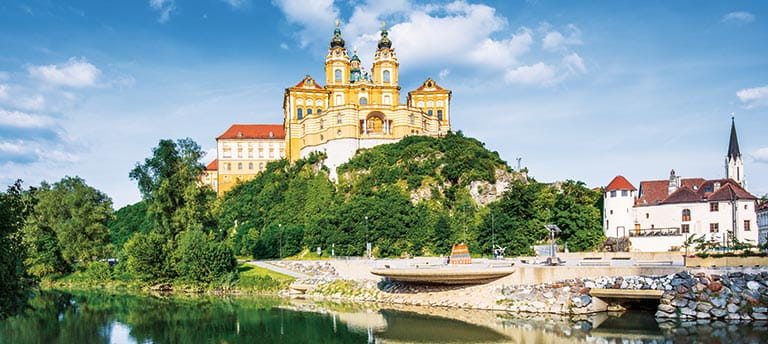
Port: Melk
The shimmering, yellow-and-white Stift Melk, its twin spires defining the skyline of this pretty riverside town, clings to a rocky promontory overlooking the Danube. While the exterior of the abbey is impressive, it's the opulence inside that really dazzles, from gleaming marble floors to elaborate frescoes, chubby cherubs and spectacular trompe l'oeil. Don't miss the library, where priceless historic books are displayed on gold-embellished bookshelves.
Fun fact: Look for the reusable coffin in the Abbey. This 18th-century invention had a trap door through which the deceased would be dropped into their grave rather than interred in the normal fashion. Unsurprisingly, the idea didn't catch on.
How can I experience this?
Christmas and New Year on Spirit of the Danube
12. Strasbourg's Old Quarter
Port: Strasbourg
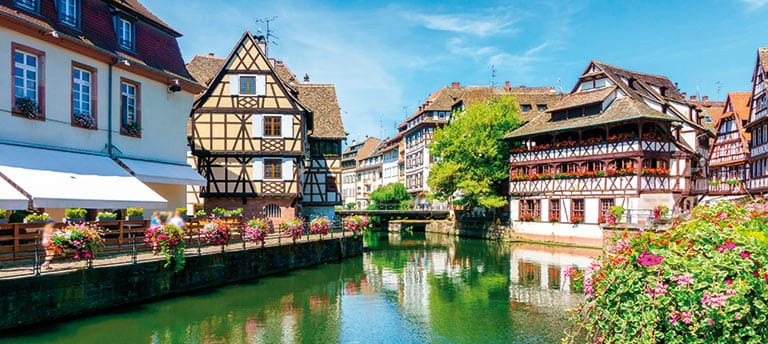
Strasbourg's delightful Petite France, a cluster of medieval and Renaissance buildings lying on the western tip of Grand Ile, is a joy to explore, all crooked half-timbered houses and window boxes that in summer cascade with scarlet geraniums. While today this is a place for a glass of chilled Alsace and a slice of tarte flambée on a sunlit square, Petite France was once a busy centre for trades that depended on the river, from tanners to millers and fishermen. Take in the scene from the Ponts Couverts, once-covered bridges built in the 13th century, spanning the River Ill.
Fun fact: The origin of the name Petite-France is less than romantic. In the 15th century, the Hospice des Vérolés here housed injured French soldiers who had fought in the Italian wars. Many were suffering from syphilis, or the "French disease".
How can I experience this?
Strasbourg, Basel and the Upper Rhine
Discover our boutique sister ships and find out more about river cruises with Saga.
The opinions expressed are those of the author and are not held by Saga unless specifically stated.
The material is for general information only and does not constitute investment, tax, legal, medical or other form of advice. You should not rely on this information to make (or refrain from making) any decisions. Always obtain independent, professional advice for your own particular situation.
More Experiences blogs
-

Christmas markets you can visit from a cruise
-
Minibreaks with a difference – they’re on water!
-
Enhance your holiday with Saga’s exciting new podcast
-
Food glorious food: on-shore culinary adventures for cruisers
-
What’s it like to spend Christmas on a cruise ship?
-
Celebrating Spirit of the Rhine